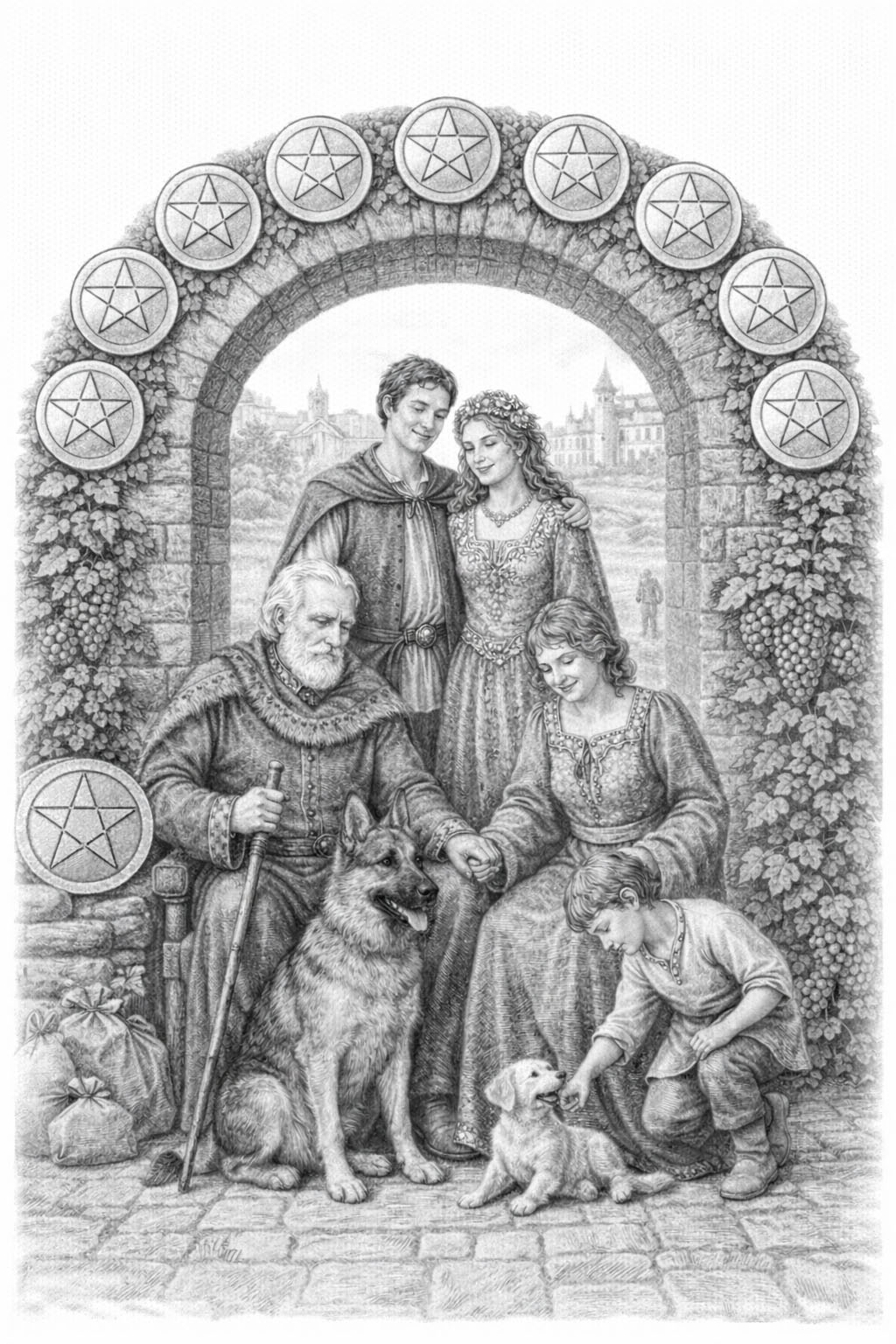
Context
meaning.love
Pentacles Ten in the context of love represents themes of material stability, family structures, and long-term arrangements. It points to relationships that are embedded in broader networks—households, kinship ties, shared assets, or community recognition—and highlights how practical considerations, traditions, and inherited patterns shape intimacy. The card emphasizes security, continuity, and the tangible aspects of partnership: living arrangements, finances, caregiving responsibilities, and legal frameworks that bind people together over time.
Interpreting this card is less about predicting a specific outcome and more about examining the texture of the relationship in concrete terms. Consider how values around wealth, possessions, and legacy are negotiated between partners and across generations. Reflect on whether domestic stability supports emotional connection or whether practical duties and expectations have become the primary glue. The image also invites scrutiny of power dynamics tied to money and family authority: who makes decisions, who carries responsibility, and how obligations to parents or children affect the couple.
Pentacles Ten can indicate a relationship oriented toward building a shared future—establishing a household, creating traditions, or formalizing arrangements—but it also cautions against complacency or rigid adherence to inherited roles. Useful questions include whether both partners’ long-term goals and definitions of security align, how financial and caregiving responsibilities are distributed, and whether the relationship allows room for individual growth within its structures. Practical steps informed by this reading might involve clear communication about expectations, transparent planning for shared assets and responsibilities, and conscious work to balance stability with emotional reciprocity.
meaning.job
Pentacles Ten in a career context represents culmination, institutional stability, and the material structure that follows sustained effort. It points to work that is embedded in larger systems—organizations, family enterprises, or established professions—where reputation, long-term planning and the transmission of resources or knowledge matter. The emphasis is on durability: contracts, policies, legacy projects and the infrastructure that supports ongoing prosperity.
Practically, this card can describe a stage in which achievements are consolidated and formalized. It may indicate steady income, recognition by peers or clients, and roles that involve stewardship—managing assets, maintaining standards, or ensuring continuity across teams or generations. It also relates to careers where social capital and trust built over time govern advancement more than rapid innovation or short-term gains.
Analytically, Pentacles Ten carries both constructive and cautionary notes. On the constructive side it highlights effective systems, succession planning, and the value of interdependence. On the cautionary side it can point to rigidity, overreliance on established ways, nepotism, or complacency that inhibits adaptation. It is useful to examine whether existing structures are serving equitable distribution and future resilience, or whether they shelter inertia.
For reflection, consider how current work contributes to long-term stability and what responsibilities come with stewardship. Evaluate governance, mentorship, and legacy: are systems being maintained with integrity, is knowledge being passed on, and is there room to evolve while preserving core strengths?
meaning.finance
The Ten of Pentacles in a financial context points to structures of sustained material stability and resources that extend beyond a single individual. It highlights established assets, family or household finances, formal agreements, property, inheritance, pension systems, and institutional frameworks that create security over the long term. Read analytically, the card emphasizes continuity, cumulative value, and the consequences of choices made across time—savings strategies, legal arrangements, and multigenerational planning matter more than short-term speculation.
This card also signals that money is often embedded in relationships and institutions: family businesses, shared estates, trusts, or company pensions may dominate the picture. That brings benefits such as pooling of resources, professional management, and economies of scale, but also complications like competing expectations, unclear succession, tax implications, and governance issues. From a practical standpoint it invites attention to documentation (wills, trusts, shareholder agreements), transparent communication among stakeholders, and review of how assets are protected and transferred.
As a diagnostic symbol, the Ten of Pentacles encourages evaluating durability and alignment: are current investments and arrangements designed to sustain intended beneficiaries, or do they perpetuate dependency or inequality? It prompts questions about diversification, legal safeguards, and the cultural values attached to wealth. Use it as a cue to consult qualified advisers (estate, tax, financial planning) and to balance preservation with adaptability so that material security serves broader goals rather than becoming a source of friction or rigidity.
meaning.family
When the Ten of Pentacles appears in a question about family, it highlights structures of material and social continuity: resources, property, legal arrangements and the cultural patterns that are passed between generations. This card points to long-term arrangements that shape day-to-day family life — ownership, inheritance, family businesses, settled routines and the values that underpin them. In readings about family it often directs attention to how stability is maintained, who holds responsibility, and which traditions or expectations are being reproduced.
The Ten of Pentacles also invites examination of intergenerational dynamics. It can signal pride in a shared legacy and practical support systems, but it can equally indicate rigid roles, unexamined entitlement or conflict over resources and decision-making. Emotional wellbeing may be overshadowed by a focus on status, continuity or material security, so it is useful to consider both the tangible and intangible assets being transmitted: financial arrangements alongside beliefs, habits and unresolved tensions.
Approaching this card analytically means asking which arrangements serve the family and which limit it. Look at whether legal and financial matters are transparent and whether family members have a voice in how resources and responsibilities are allocated. Consider the balance between preserving heritage and allowing change, and whether rituals and structures are inclusive rather than exclusionary. The Ten of Pentacles is fundamentally about legacy — understanding what is being preserved and why, and how those choices shape present relationships and future possibilities.
meaning.mind
The Ten of Pentacles, when considered as a description of psychological state, points to a mindset anchored in security, continuity, and the material or social structures that support identity. It reflects a strong sense of belonging and legacy: personal worth is often intertwined with family roles, traditions, accumulated achievements, and the maintenance of established systems. Emotionally this can feel reassuring and proud, with confidence derived from stability and visible accomplishments. At the same time the same orientation can produce rigidity, an aversion to change, or a reliance on external markers of success for self-esteem. Patterns and expectations handed down across generations may be accepted without question, reinforcing conformity or duty over personal exploration.
From an analytical perspective the card highlights tensions between collective responsibility and individual autonomy, between preservation and growth. Psychological work aligned with this pattern involves examining which loyalties and values are genuinely chosen versus inherited, clarifying boundaries around obligation, and exploring flexibility in identity beyond material or familial status. It also invites reflection on how security is constructed and whether that construction supports authentic well-being or primarily protects against uncertainty.
meaning.soul
When the Ten of Pentacles appears as a description of an inner state, it points to a mind shaped by concerns of stability, continuity and belonging. Emotionally there is a strong emphasis on security: the person feels anchored by tangible accomplishments, family ties, or a clear place in a social or material order. This can bring calm, satisfaction and a sense that life is built on solid foundations.
At the same time the card highlights an orientation toward legacy and long-term thinking. Thoughts and feelings are often filtered through questions of inheritance, responsibility, and the ways personal choices affect others across time. Pride and gratitude for what has been established coexist with a pragmatic attention to assets, resources and traditions.
There is also a potential shadow side in this state of mind: attachment to stability can become rigidity, and identification with status or lineage can limit spontaneity or stop personal change. Anxiety may arise around the prospect of losing security, or resentment may grow under the weight of duty. Reflecting on whether security is serving growth or constraining it helps bring balance: acknowledging the comfort of roots while allowing room for personal evolution and emotional authenticity.