Context
meaning.love
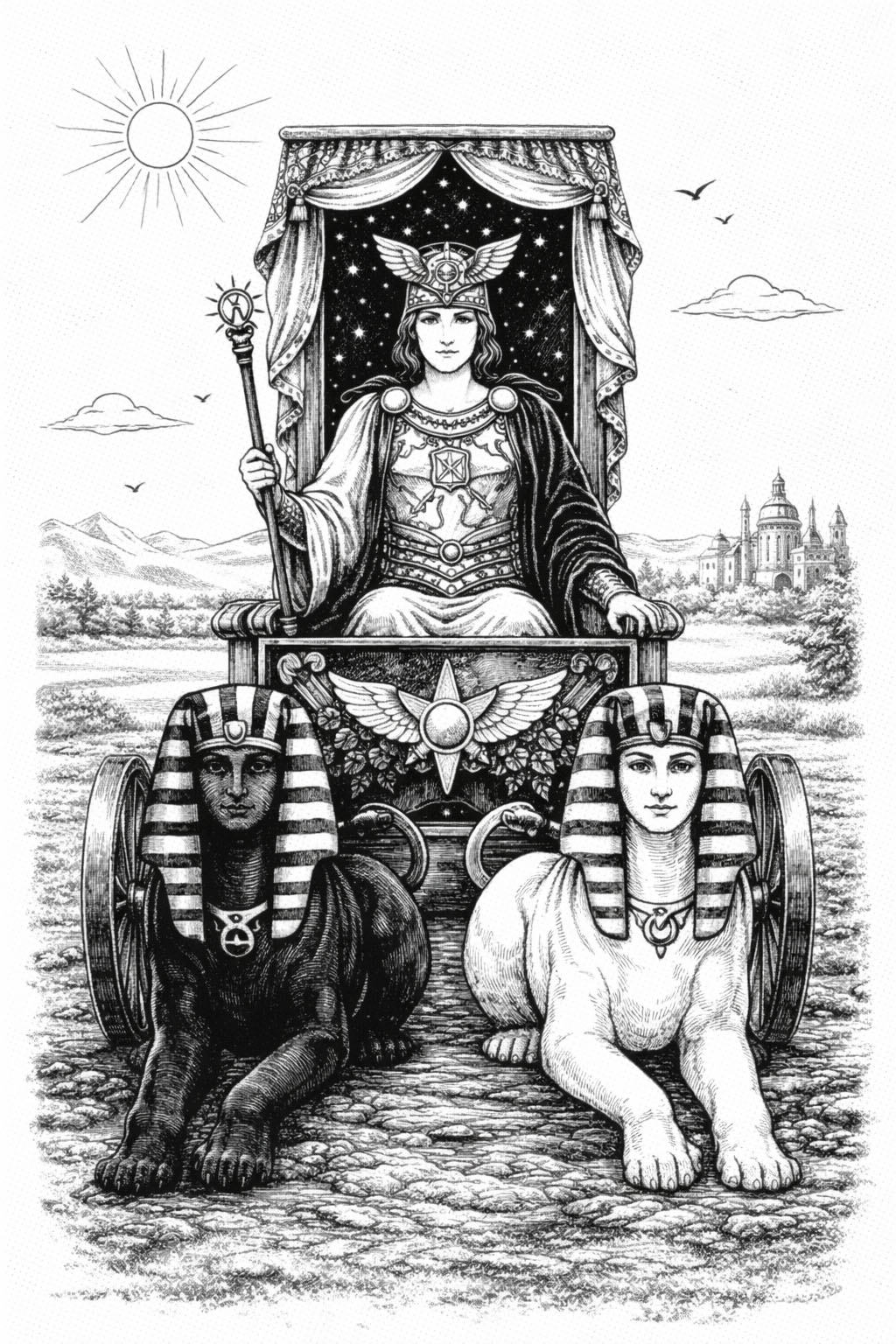
In a love context, The Chariot represents movement driven by will, focus, and the need to steer conflicting impulses toward a single direction. It highlights the role of agency and determination in relationships: progress often depends on clear intention, consistent effort, and the ability to reconcile opposing needs rather than letting them pull the partnership apart. The card points to a dynamic where momentum and goal-orientation are prominent themes.
Psychologically, The Chariot emphasizes self-mastery and emotional regulation. Effective forward movement in love requires awareness of one’s motivations and restraint of impulsive reactions. Confidence and decisiveness can be attractive and useful, but if unchecked they can shift into controlling behavior or impatience. The card therefore invites examination of how aggression, pride, or inflexibility might be mistaken for strength.
Practically, The Chariot encourages clarifying direction with a partner: articulate shared aims, negotiate differences about pace and boundaries, and coordinate effort so that both people are contributing to the same trajectory. For someone single, it often signals a period of focused self-development and purposeful action that can make one more ready for healthy partnership; confidence cultivated through self-discipline tends to be more sustainable than forcing encounters.
Overall, The Chariot is about harnessing energy and aligning will with intention. Its constructive expression supports mutual movement and conscious decision-making; its shadow involves domination or hurried choices. Awareness, communication, and ethical assertiveness are key to turning its momentum into relational growth rather than conflict.
meaning.job
In a career context, the Chariot symbolizes focused direction, disciplined effort, and the mobilization of resources toward a clear objective. It represents the ability to coordinate different skills, teams, or competing demands and to apply determination and strategic willpower to advance a project, role, or professional trajectory. The image points less to passive luck and more to active steering: momentum is built through planning, decisive action, and sustained concentration.
Practically, the Chariot can appear when progress depends on asserting priorities, setting measurable targets, and maintaining control over logistics and timelines. It highlights situations where leadership, project management, or a visible demonstration of competence will influence outcomes. The card also draws attention to the need to reconcile opposing forces—such as conflicting stakeholders, personal ambitions versus team needs, or short-term pressures versus long-term goals—by establishing clear boundaries and aligning efforts toward a single direction.
As an analytical cue, the Chariot invites examination of where determination is productive and where it risks becoming rigid or domineering. It suggests evaluating whether current strategies require stronger focus, clearer communication, or better integration of disparate elements, and whether endurance and discipline are being balanced with ethical considerations and self-care. Useful questions to explore include: what concrete goal is being pursued, which resources need to be marshaled, what tensions must be harmonized, and how progress will be measured. Interpreted this way, the Chariot serves as a framework for understanding career dynamics that depend on intention, management of opposing forces, and the steady application of will.
meaning.finance
In a financial context, The Chariot emphasizes direction, control, and the disciplined application of will to achieve monetary objectives. It points to situations where progress depends on clear goals, focused action, and the ability to coordinate competing demands—such as balancing short-term cashflow with longer-term investments. Financial momentum or an uptick in opportunity may be present, but realizing benefit requires assertive management: setting priorities, enforcing budgets, pursuing receivables, and steering resources deliberately rather than responding passively.
Analytically, the card highlights strengths like determination, strategic planning, and effective execution, along with potential pitfalls such as impatience, overconfidence, or trying to force a result without attending to practical details. It can also indicate the need to reconcile opposing forces—multiple income streams, partners with different priorities, or conflicting expenditures—so that they work together toward a common objective. For decision-making, The Chariot advocates for disciplined action informed by a clear plan and ongoing monitoring rather than impulsive moves; when control and coordination are maintained, the prospects for forward movement improve.
meaning.family
The Chariot in a family context emphasizes direction, control and coordinated effort. It indicates a focus on moving the household forward through determination, planning and active management of practical matters. This can show a family member stepping into a leadership or organizational role, taking responsibility for logistics, timelines and clear decisions so that the group can make progress on concrete goals such as relocation, budgeting, education or caregiving arrangements.
At the same time the image highlights opposing forces that must be steered and balanced: differing needs and opinions among partners, generational perspectives, or external pressures. The constructive expression involves disciplined follow-through, clear boundaries and the ability to channel energy into achievable tasks while keeping the shared aim in sight. The less constructive side appears as rigid control, impatience, or pushing decisions without accommodating emotional needs; this risks friction, resentment or burnout.
For practical use, the card points to the value of combining assertiveness with attentive communication: define objectives, agree roles, coordinate steps and remain open to adjustment. Success depends less on brute force than on steady steering—maintaining cohesion by integrating willpower with empathy, scheduling realistic actions, and checking that everyone’s concerns are acknowledged as the family moves forward.
meaning.mind
When The Chariot appears in the context of psychological state it points to a mode of mind characterized by strong will, focused intention and an urge to move forward. Mental energy is organized around achieving specific aims; impulse control, discipline and the capacity to concentrate under pressure are emphasized. There is often a sense of inner momentum and confidence, accompanied by a readiness to overcome obstacles through determination and strategic action. At the same time this configuration can reveal internal tensions: competing drives may be tightly controlled rather than integrated, producing rigidity, impatience or suppression of softer feelings. Overreliance on sheer will can lead to burnout, tunnel vision or difficulties in recognizing when adaptation or cooperation would be more effective. Psychologically, The Chariot invites reflection on the source and alignment of one’s motivations, on whether autonomy is being asserted constructively or defensively, and on the balance between control and receptivity. Practical therapeutic considerations include cultivating self-awareness about underlying needs, allowing space for emotions to inform decisions, and developing flexible strategies that harness drive without neglecting rest, empathy or ethical boundaries.
meaning.soul
When The Chariot appears in relation to a person's state of mind, it commonly indicates a concentrated, forward-driving energy. It points to a mental stance characterized by determination, focus, and an intent to steer circumstances rather than be passively carried by them. This can show clear goals, disciplined attention, and a willingness to exert willpower to overcome obstacles. The imagery of harnessing opposing forces suggests that the mind is actively negotiating internal conflicts—bringing impulses, doubts, and desires into alignment with a chosen direction.
At the same time, The Chariot highlights the tension between control and suppression. The same drive that enables progress can also lead to rigidity: emotions may be tightly managed or compartmentalized in service of momentum, which can produce strain if underlying feelings are ignored. Anxiety or impatience can accompany the need to maintain course, and there may be a tendency to prioritize achievement over emotional processing. Psychologically, the card often reflects confidence and resilience coupled with a need to balance assertiveness with responsiveness to inner states. Viewed educationally, it encourages understanding how focused will and disciplined strategy shape one’s inner life, and invites attention to whether that control is integrative or masking unresolved affect.